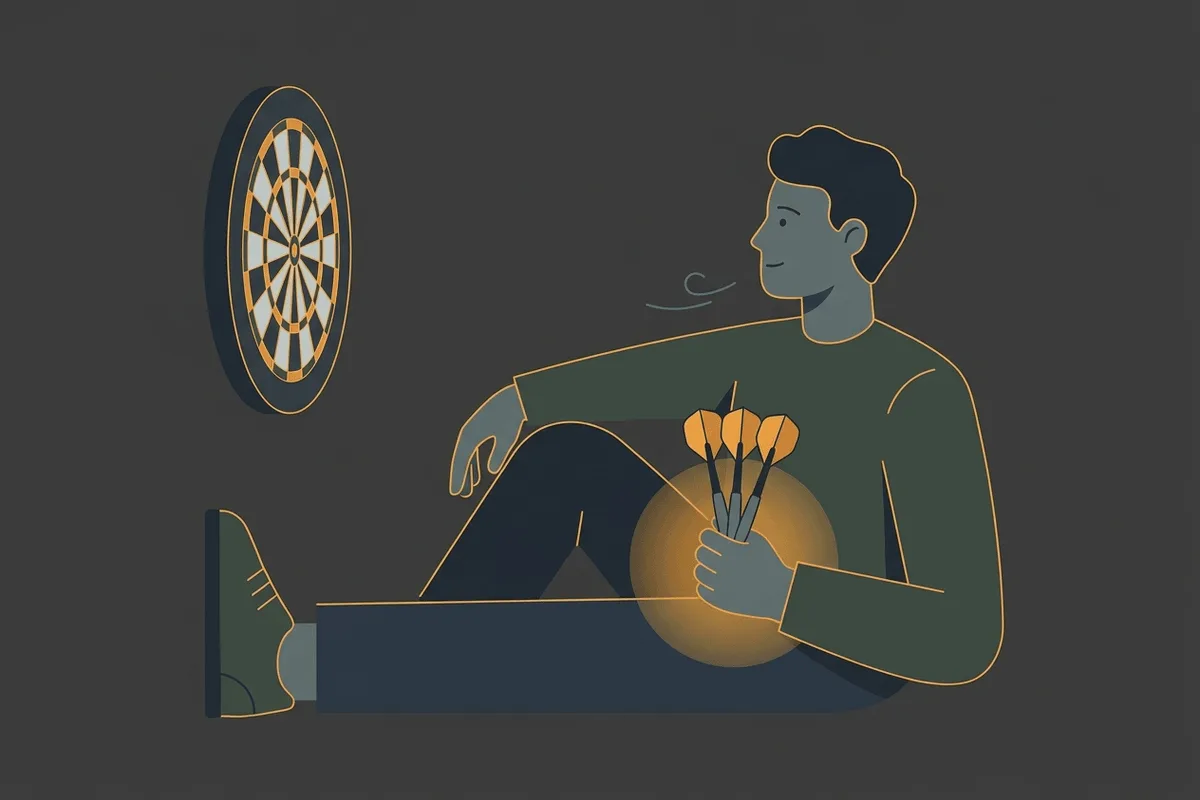
Learn

Learn to Throw & Aim

Throwing a dart isn't complicated, but a few simple habits make all the difference between a dart that sticks and one that goes astray. Here are the fundamentals, chapter by chapter, to build good technique from the start.
The Grip

1The Grip

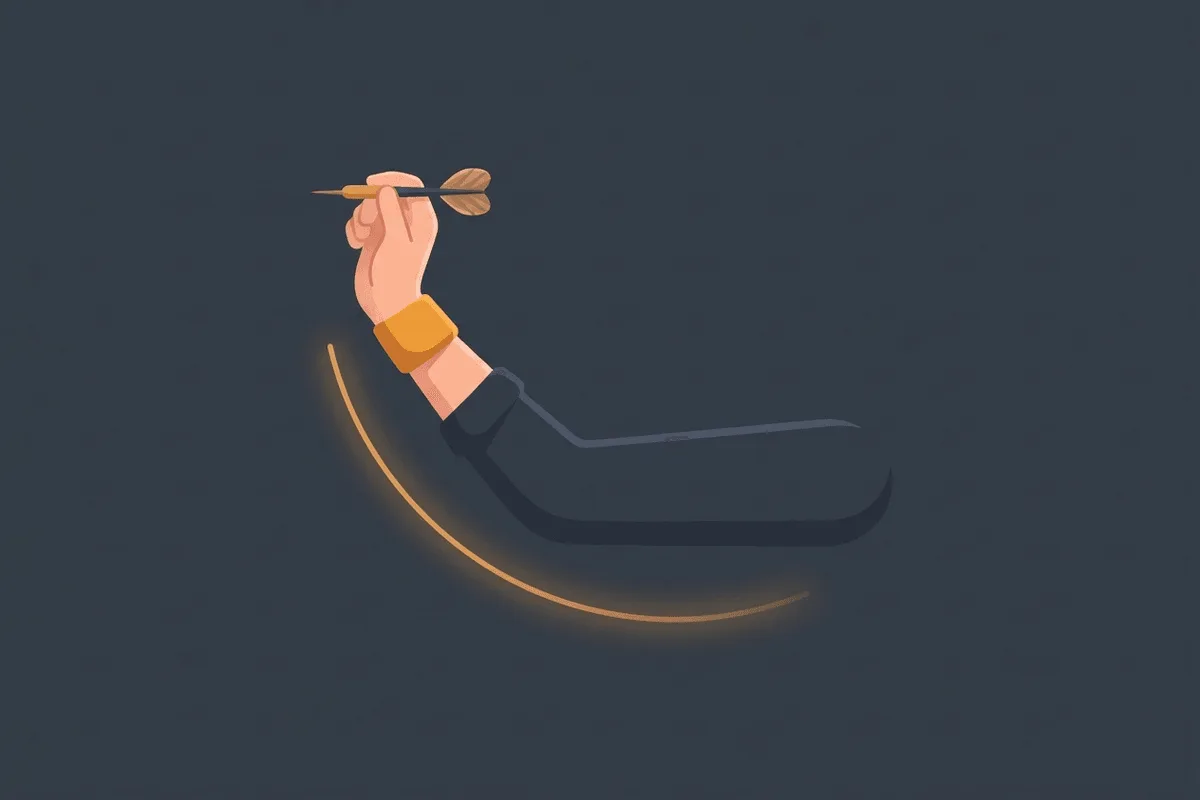
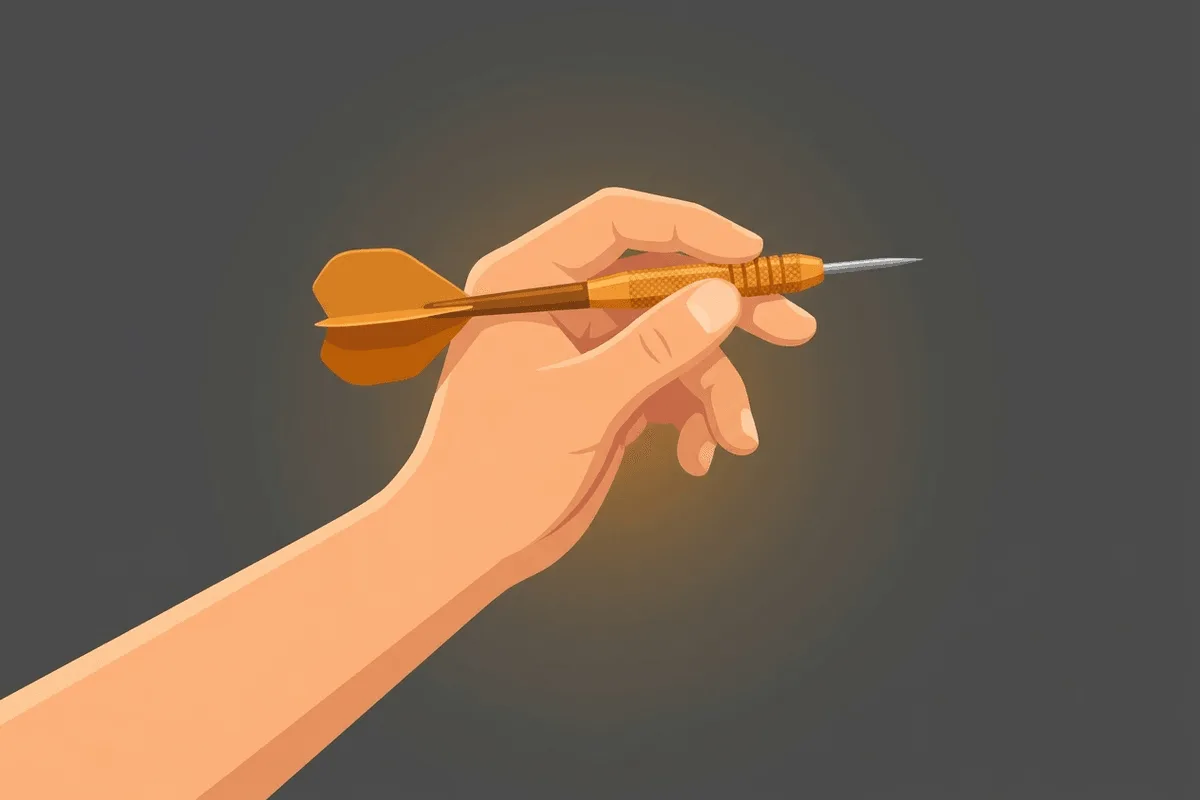
Hold the dart like a pen, resting on the last joint of your thumb and index finger, with your middle finger providing support. It's the barrel (the central section, usually knurled) that you grip — that's exactly what it's designed for.

Find the balance point of the dart and place your fingers just behind it. If the tip angles downward, move your grip back slightly; if it angles too high, shift it forward.

Stay relaxed. A tense grip locks up the movement and sends the dart off course. You should be able to hold the dart firmly without your fingers turning white.

Tip · Always use the same grip, throw after throw. Consistency starts in your fingers.
Stance & Balance

2Stance & Balance

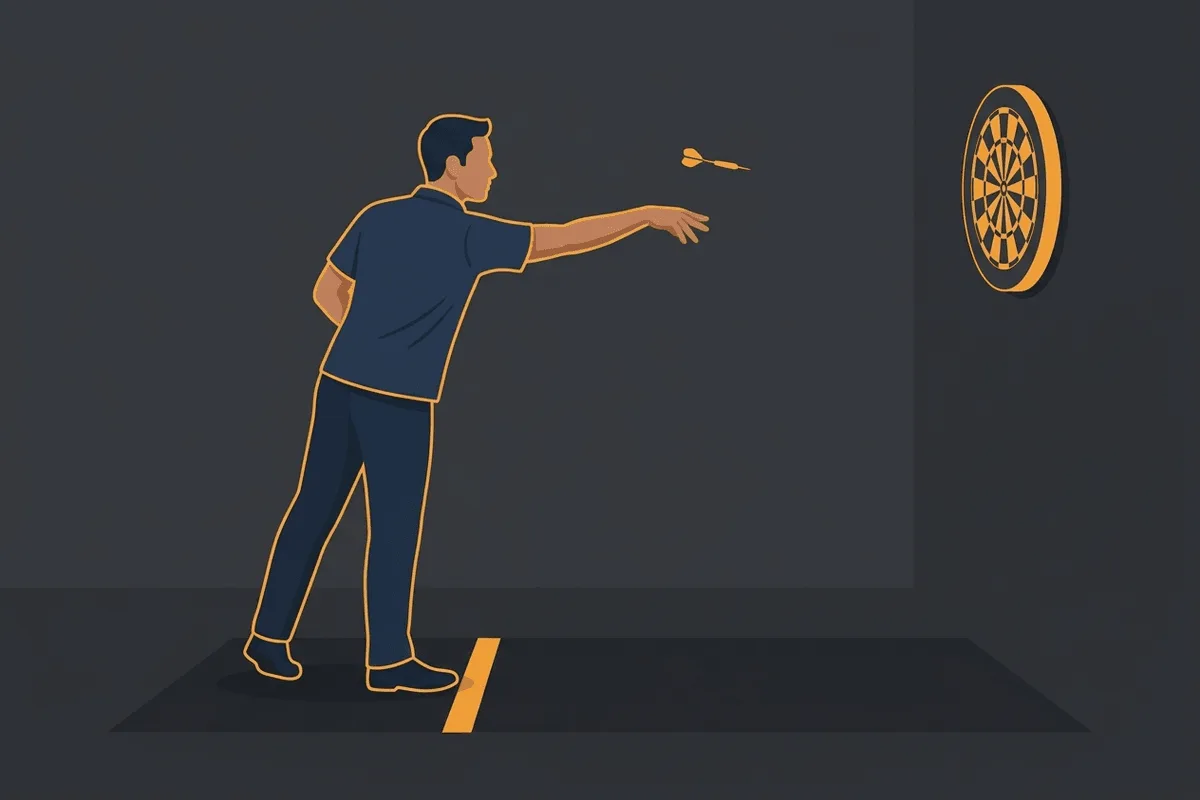
Place your front foot on the oche (the throwing line), pointed towards the board. This foot carries most of your weight and acts as your anchor.

Turn your body side-on, with your throwing shoulder facing the board. This shortens the distance between your hand and the target and improves your accuracy.

Lean your upper body slightly forward, but stay stable and still. Your lower body doesn't move during the throw — only your arm does the work.

Tip · Find a comfortable position you could reproduce with your eyes closed. Comfort breeds consistency.
The Throwing Action

3The Throwing Action

Raise your forearm until the dart is level with your eye. Your elbow stays high and pointed at the target — it acts as the hinge of your throw.

Only your forearm moves. Draw back to load the throw, then drive forward to release. Your upper arm stays virtually still throughout.

The action should be smooth, not forceful. Speed comes from the natural release of the movement, not from brute strength. A dart is delivered, not hurled.

Tip · If your elbow drops or drifts to the side, the dart will veer off. Keep it steady from start to finish.
Aiming & Alignment

4Aiming & Alignment

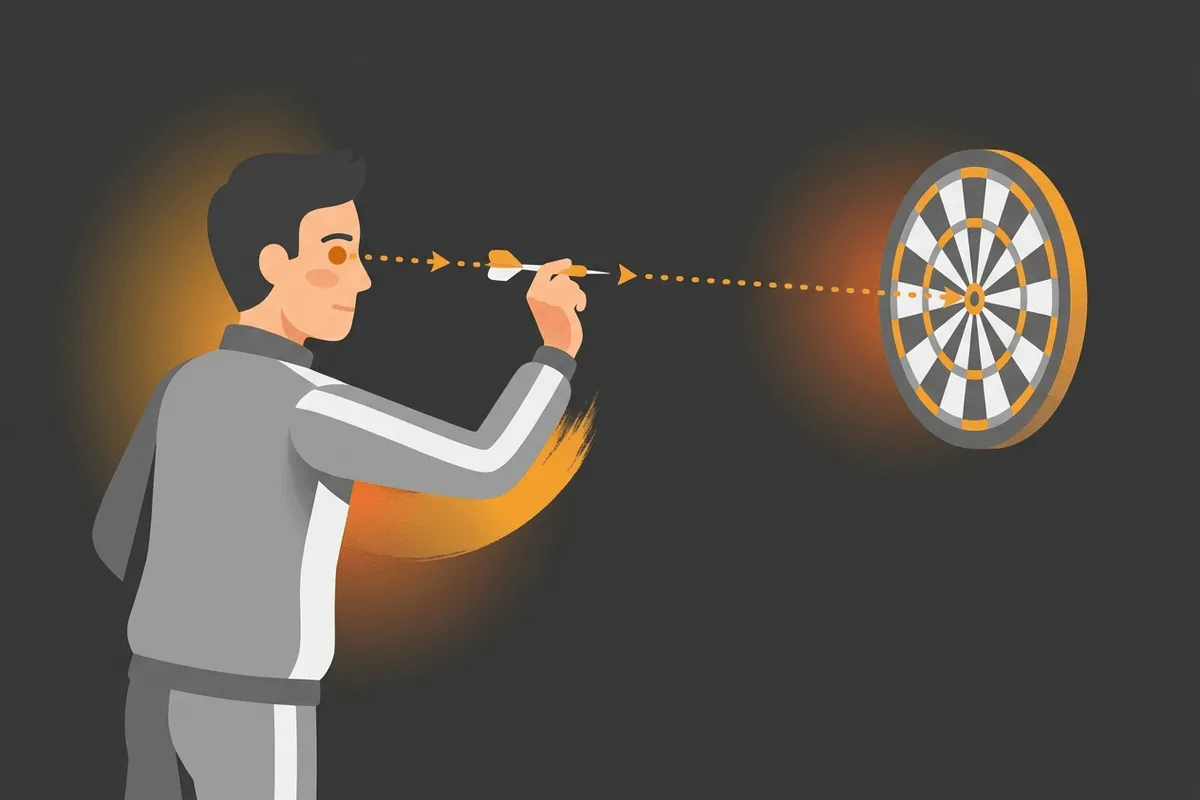
Line up three points on the same axis: your dominant eye, the dart tip, and the target zone. Closing your other eye often helps you see this line more clearly.

Fix your gaze on the target, not on the dart. Your brain will self-correct if you give it a clear, precise focal point — aim at a spot, not just "the 20 area".

When starting out, aim for the bull or the single 20: these are forgiving zones that teach you to repeat the same action consistently.

Tip · Aim at the smallest target you can. Aim small, miss small; aim big, miss big.
The Release & Follow-Through

5The Release & Follow-Through

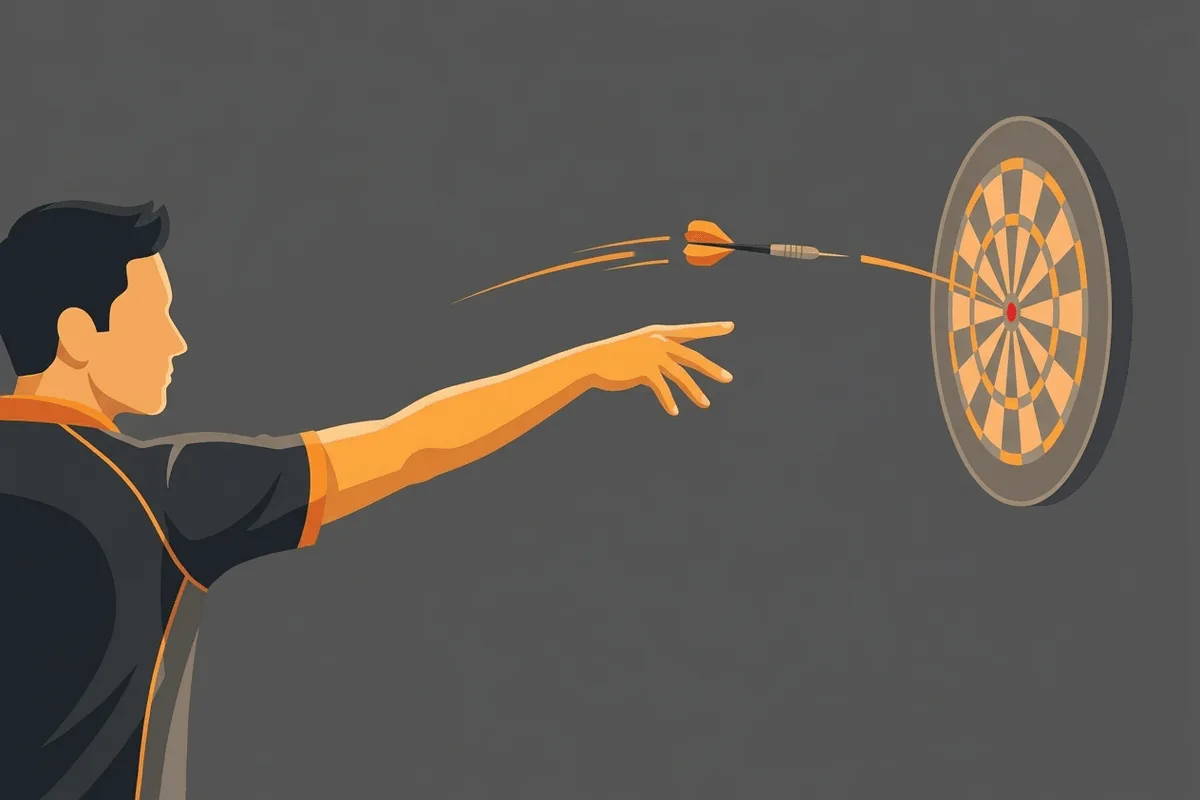
Release the dart when your forearm is fully extended forward, at the highest point of the throwing action. Your fingers open together, smoothly, so as not to deflect the tip.

Continue the movement after release — that's the follow-through. Your arm extends towards the target and, at the end of the action, your index finger naturally points at where you aimed.

Never cut your throw short. A throw that's braked mid-flight loses both accuracy and consistency.

Tip · At the end of your throw, your hand should "salute" the target with your fingers pointing at it. That's the hallmark of a good follow-through.
Consistency

6Consistency

The secret of good players isn't power — it's repeating the same action every time. Grip, stance, draw, release: always identical.

Build a small pre-throw routine — a breath, a look at the target, then the throw. It settles your arm and locks in consistency.

Practise regularly, even for just a few minutes. The app's guided exercises (Around the Doubles, T20…) are built for exactly this: they expose your weaknesses and sharpen your aim.

Tip · Fifteen minutes every day beats one long session once a week. Consistency beats intensity.
Your turn

Your board is ready?
PlayDart counts the rest.

Free, offline, ad-free. One minute to start your first 501.

Open PlayDart